
Professional Oven Care / Fulham
Oven Cleaning Fulham
Give the roasting oven a proper reset.
A tray of roast vegetables can leave sticky oil on the runners long after dinner is finished. If the racks drag, the glass is cloudy or spills have baked into the floor, start with an inspection rather than another hurried scrub. Discuss oven cleaning for your Fulham address with Professional Oven Care, describing the appliance and the parts that need attention. Your postcode, access arrangements and complete quote are checked before a booking is agreed.
Separate attention for removable racks
Advice for sticky roasting deposits
An agreed appliance scope
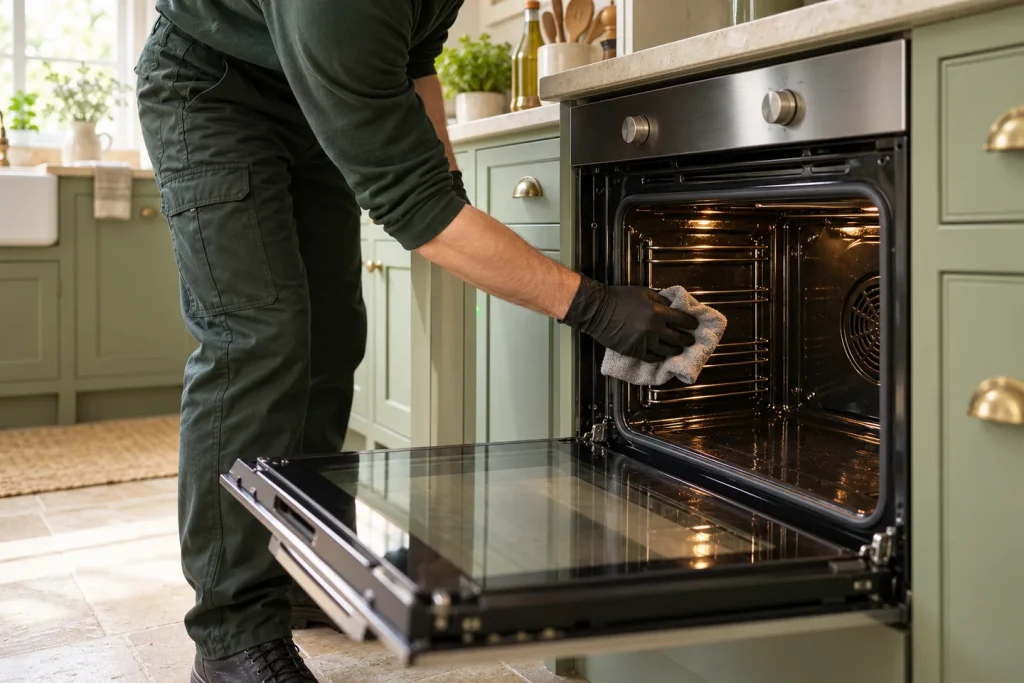
From Sunday lunch to everyday baking
Describe the residue, not just the oven size.
Cooking habits provide useful clues when discussing a clean. Roasting fat can collect around tray edges and supports, while sweet sauces leave different deposits on enamel and glass. Explain where the build-up sits and whether a spill is recent or has been reheated repeatedly. This helps establish the likely work without pretending that every brown mark is the same substance.
A photograph of the open, cold oven and the model label can clarify a telephone enquiry. Include both cavities if you have a double oven, and show any tray or rack that you want included. Avoid pulling the cooker out to find a label; look in the manual or around the accessible door frame first.
The main oven cleaning London guide explains the wider service. Here the priority is a practical plan for your own kitchen: identify the surfaces, agree the removable components and leave enough room for careful work. London-wide service information does not establish availability at a particular Fulham address, so confirm the full postcode.
Racks deserve their own treatment
Free the supports without forcing the fittings.
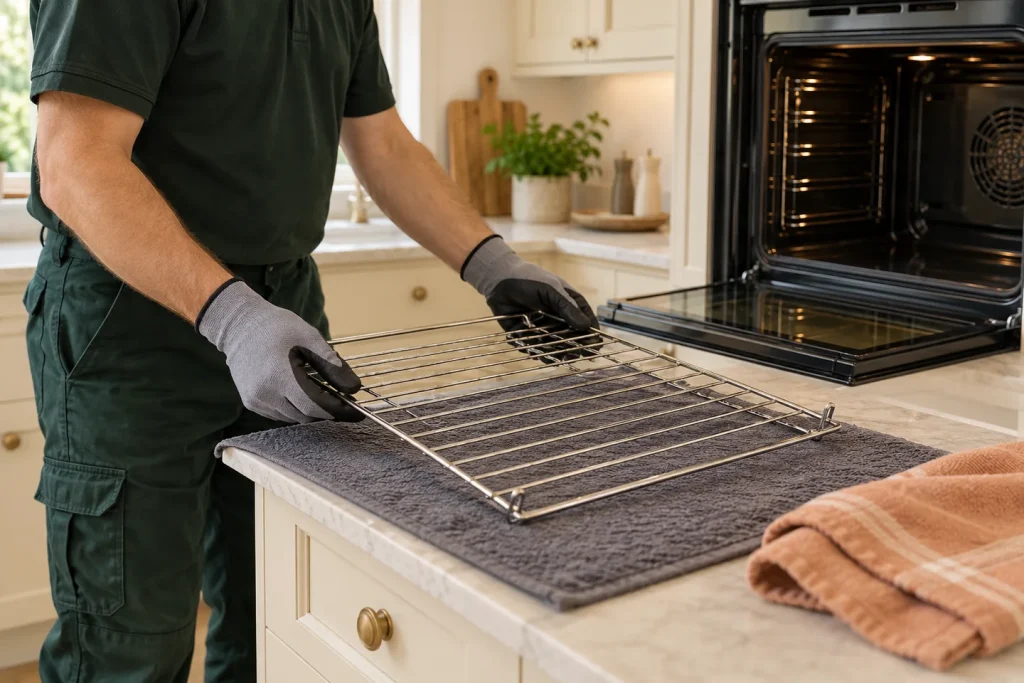
A rack may look clean from above while its underside carries a ridge of residue. Appropriate removable shelves, side supports and trays can be treated separately from the oven cavity. The published service process includes a dip tank for suitable parts. Whether a particular accessory is suitable depends on its material, finish and condition, rather than simply whether it fits inside.
Telescopic runners need particular consideration. Their moving sections and any manufacturer instructions should be identified before cleaning; they are not interchangeable with a plain wire shelf. Mention stiff runners or missing stops during the enquiry. Do not use force to remove a seized support or try to prise apart a moving mechanism.
The door and cavity require their own approach. Accessible glass may be cleaned or detached where the design allows, but damaged fittings can limit dismantling. Explain any loose handle, chipped edge or worn seal before work begins. The aim is appropriate deposit removal while recognising existing wear, rather than promising a factory-new finish.
Make the booking match the cooking
Include the parts you use most.
Count compartments and accessories separately. A cooker with one main oven and a small grill can involve two working spaces even if you rarely use the top one. Ask whether the grill pan, roasting tray and supports are included. An apparently simple description such as “standard cooker” leaves too much room for misunderstanding about the work.
If oil has also accumulated around the splashback or cupboards, consider deep kitchen cleaning as a separate room service. Its basic oven element is different from specialist dismantling and dip-tank cleaning. Agree which service addresses each priority instead of booking two overlapping descriptions and expecting an identical process.
Preparing for a larger food shop may also make fridge cleaning useful. That requires its own plan for food storage and access, so raise it before an appointment rather than when the oven clean is nearly finished. The table below is a conversation aid, not a promise that every accessory is automatically included.
| Part to identify | Work to discuss | Useful booking detail |
|---|---|---|
| Main roasting cavity | Accessible enamel and door glass | Heavy spills and liner type |
| Wire shelves | Separate treatment where suitable | Number and condition |
| Telescopic supports | Model-specific cleaning limits | Stiff movement or damaged stops |
| Grill compartment | Agreed cavity and pan cleaning | Whether regularly used |
Prepare without pre-cleaning
A cool appliance and a clear work area help.
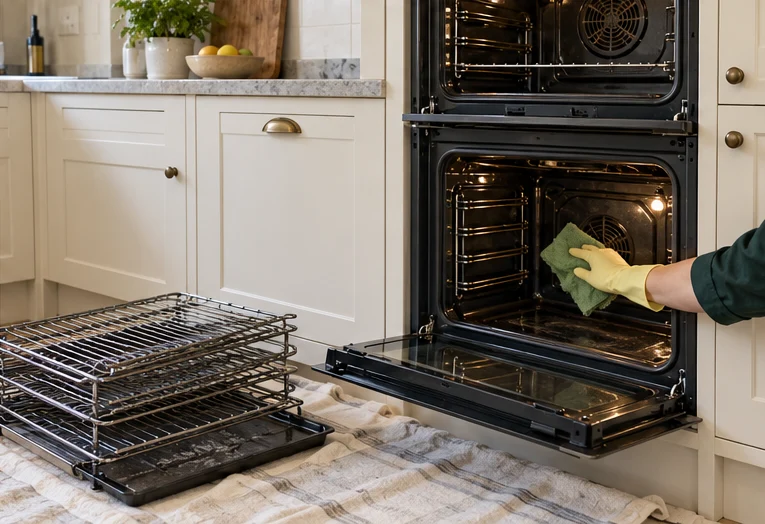
Finish cooking early enough for the oven, racks and glass to become fully cool. Remove food, loose packaging and any personal items stored in the cavity. Clear a nearby work surface without covering the hob in belongings that will have to be moved again. Keep the doorway and route into the kitchen usable throughout the visit.
Leave the components assembled for the initial inspection. Removing a door or glass panel beforehand can obscure a pre-existing fault and create a difficult refitting problem. If you have already taken something off, tell the team and keep all fixings together. Do not conceal a broken clip simply because the part appears to sit back in place.
Tell the technician about any recent cleaning product and avoid adding another treatment immediately before arrival. Provide access to the water and electricity discussed when booking. If a child or pet normally moves through the working area, make an arrangement that keeps the route clear without interrupting essential household access.
Access at your actual address
Plan the arrival before planning dinner.
For council parking information, consult Hammersmith & Fulham parking guidance and check the signs at the address. Explain any controlled bay or access restriction before the visit is arranged.
An entry code alone may not be enough if the kitchen is behind a second shared door. Describe the route from the entrance, whether a lift can be used and who will answer the phone. These are questions about the individual property, not assumptions about the type of homes found across Fulham.
If you are coordinating the work from elsewhere, leave one reliable contact responsible for access and approval of the scope. Share parking or building instructions directly with the team once the appointment details are confirmed. Do not reserve a time-specific arrangement on the assumption that an enquiry has already become a booking.
After the racks go back
Check the result where you actually cook.
At handover, look at the agreed components and ask about any remaining marks. A baked deposit, a scratch and worn enamel can appear similar at first glance but have different limits. Cleaning should not be used to disguise damage, and a stain that cannot appropriately be removed deserves an explanation rather than increasingly aggressive treatment.
Ask how to use the appliance after cleaning and refitting. Follow advice for the model and leave time for any recommended empty warm-up before preparing food. Avoid scheduling a meal for the moment you expect the visit to end. Larger appliances and more involved fittings can change the working time discussed during the enquiry.
Keep the complete quote tied to the oven configuration, accessories and any additional work you agreed. Tell the team about a failure to heat, an electrical trip or a mechanical defect at the enquiry stage, with cleaning and fault investigation discussed separately. A clear scope makes it easier to judge the service without expecting deposit removal to repair an underlying fault.
Questions before booking
Fulham oven care: the details worth checking.
Should I soak the racks before the visit?
Leave them available for assessment unless the team gives different instructions. A coating or moving mechanism may need a different approach from ordinary wire shelving. Explain any treatment you have already used so the technician can choose a compatible method.
Can burnt roasting juices be removed from the floor?
Discuss the affected surface and severity. Suitable residue can be addressed, but worn enamel or heat damage may remain visible. A photograph helps describe the problem; an inspection establishes appropriate limits without assuming that every dark patch is removable.
Is the top grill part of a single-oven booking?
It needs to be identified separately. Tell the team if there is a second compartment, even if you seldom use it. Ask for the grill pan and supports to be named in the agreed scope rather than inferring inclusion from the cooker width.
Can I book just before guests arrive?
Allow a practical buffer for access, cleaning, refitting and the instructions given afterwards. Availability and timing are confirmed for the address and appliance. A last-minute meal deadline should be discussed in advance rather than treated as an automatic completion guarantee.
What information makes a Fulham enquiry easier?
Have the full postcode, cavity count, make or model and the main problem ready. Add access instructions and any proposed extras. The team can then discuss a complete quote and availability for the actual property instead of relying on an area name alone.
Planning a visit at another address?
Explore the surrounding area guides.
For another household, read the guides for Hammersmith, Putney, Chelsea. Find the full collection in Areas We Cover. These guides help you prepare an enquiry; availability is confirmed for the full postcode.
Professional Oven Care / Fulham
Ready to discuss your oven?
Call with the model, condition and access details. Confirm the work and complete quote before arranging your appointment.