
The kitchen care journal
“Natural” oven cleaning: start with the surface, not the recipe
A familiar household ingredient is not automatically a suitable oven cleaner. The useful starting point is the appliance’s care guidance: what the surface is, what can be removed and which products the manufacturer allows.
In this guide
Find out what the oven is lined with
Be cautious with household recipes
Make routine cleaning more targeted
Find out what the oven is lined with
Catalytic liners, enamel and other specialist finishes can have different care requirements. Identify the model and read the manual before applying a paste, spray or abrasive pad.
A self-cleaning programme also has specific instructions. Do not combine a programme and cleaning products just because both are intended to deal with residue. Follow the appliance guidance.
Be cautious with household recipes
An acidic ingredient, abrasive powder or improvised mixture can be unsuitable for a coating, seal or nearby surface. “Natural” does not tell you whether it is compatible with your oven.
Do not mix cleaning products. Follow labels, quantities and ventilation instructions, and keep household members away from the work area as directed. Ask about sensitivities before a professional visit.
Make routine cleaning more targeted
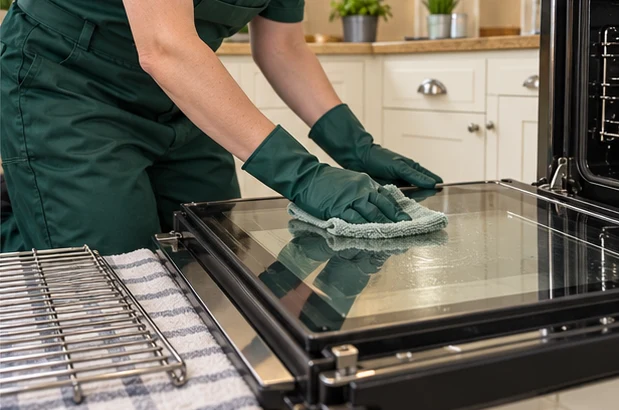
A cooled spill on an accessible surface may need a different approach from hardened deposits around racks. Address the part in question using the approved method rather than spreading a product across the whole appliance.
Avoid putting liquid into controls, vents or other areas the instructions do not permit. Surface cleaning is not a reason to explore internal components.
Separate the removable parts from the fixed surfaces
Some racks and trays can be removed for cleaning; specialist coatings may need gentler treatment. Check before soaking. Keep track of fittings and do not force a part that resists removal.
For a professional clean, explain the condition and any previous product use. Suitable removable components can receive separate attention, while the cavity is treated for its actual surface.
Worth keeping in mind
Four useful questions
What is the surface? What does the manual permit? Is this part removable? Is the mark residue or damage? These answers are more useful than an all-purpose homemade recipe.
Prefer a realistic result to repeated experiments
Permanent staining, worn enamel and scratches may remain after residue is removed. A stronger mixture does not make damaged glass new. Stop if the finish changes or you are uncertain.
If an appliance is heavily soiled, call to discuss the model and scope. Ask what method is appropriate and what aftercare applies, rather than choosing a service only by a broad product claim.

When professional help is useful